
Nobody checks the BBB anymore. Except AI.
BBB is the second-most-cited source when AI recommends a plumber. Here's how to claim the free profile, fix your complaint record, and skip the paid part.
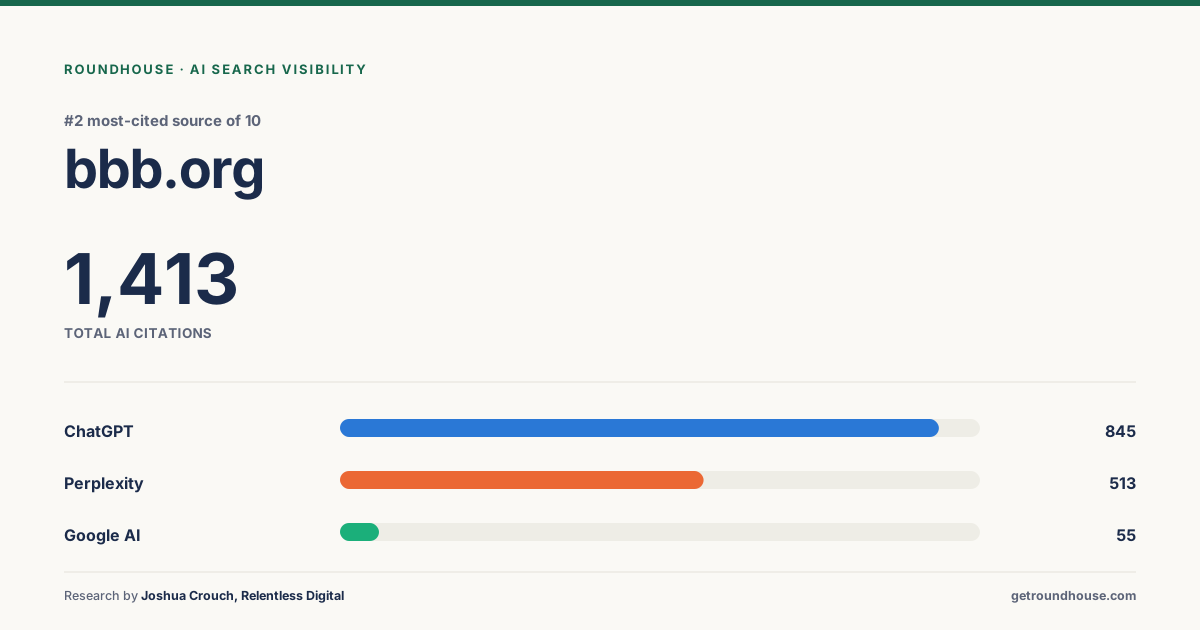
Out of 9,293 citations we logged across roughly 14,000 AI searches for residential plumbing services, bbb.org accounted for 1,413 of them. That is 845 from ChatGPT, 513 from Perplexity, 55 from Google AI Overviews. Second place overall. Which is strange, because if you asked the last ten homeowners who called you when they last visited the Better Business Bureau website, most of them would say never, and the ones under 40 would ask what the BBB is.
The short answer: Claim your free BBB profile at bbb.org/get-listed, because BBB has probably already built one for you and your complaint record is public whether you pay or not. Paid accreditation is optional and is a marketing expense, not a credential.
The 90-second version, if you'd rather read it: BBB took 1,413 of the 9,293 citations we logged — 845 ChatGPT, 513 Perplexity, 55 Google AI — which makes it the second most-quoted source in the study. There are two separate things here and people mix them up constantly: the free listing at bbb.org/get-listed, which costs nothing and probably already exists under your name, and accreditation, which is the paid one and runs somewhere around $500 to $1,500 a year depending on your local chapter. Accreditation does not improve your rating. What actually moves the needle is that your complaint resolution rate is public, and AI reads it out loud — an unresolved complaint from three years ago is sitting on that page right now. Going and resolving it is free.
Homeowners stopped reading it. The machines did not.
Here is the disconnect. The BBB spent eighty years as the place your grandmother checked before hiring anyone. Then Google reviews happened, then Nextdoor, then the reviews tab of every app on earth, and consumer traffic to bbb.org became largely a boomer activity. Plenty of plumbers dropped their accreditation in the 2010s and noticed absolutely nothing.
But language models were trained on a web where bbb.org is an enormous, structured, well-crawled, high-authority database of American businesses. Every profile has a consistent shape: name, address, phone, years in business, category, rating, complaint count, complaint outcomes. That is exactly the kind of page a model reaches for when a user types "is Ridgeline Plumbing in Tulsa legit." It is clean data about entities, published by an organisation that reads as neutral.
So the BBB has quietly become infrastructure. Nobody visits, everybody cites. We walk through the full ranking of what these models actually read in the hub post on the websites AI reads before recommending a plumber, and BBB is not an outlier in this — most of the top sources are directories homeowners no longer open.
Your complaint record is public and quotable whether you pay or not
This is the part that gets ignored, so read it twice.
BBB publishes profiles for accredited and non-accredited businesses alike. If someone files a complaint against your company, the process runs the same either way: BBB forwards it to you within two business days, you have 14 calendar days to respond, and complaints are generally closed within about 30 days of filing. Every complaint is then reportable on your profile for three years from the date it was filed.
Each one closes with a status: Resolved, Answered, Unresolved, Unanswered, or Unpursuable. BBB publishes the complaint text and your response text. That last bit is the whole ballgame. When a model summarises your company, it is not reading your rating in isolation — it can read the actual sentences a customer wrote about your water heater install and the actual sentences you wrote back. Or the conspicuous absence of them.
Two plumbing companies, both with four complaints in three years. Company A responded to all four, three closed Resolved. Company B ignored all four, all closed Unanswered. Both have a BBB page. Ask ChatGPT which one to call and see what happens.
And on the rating itself: BBB's own FAQ is unusually blunt that accreditation is voluntary and separate from the rating, and that the rating is based on complaint history and customer interactions, not on whether a business pays dues. You can be sitting on an A+ having never sent them a dollar. You can also be sitting on an F you have never looked at.
Go look at yours right now. Search your company name on bbb.org before you read the next section.
Claiming the free profile: what it actually gets you
Claiming is free and takes about ten minutes at bbb.org/get-listed. In most cases you are not creating anything — you are taking control of a profile that already exists, built from public records, with your old suite number on it.
Here is the honest split between free and paid, because the trade-off is real and most agencies will not tell you what you lose by not paying.
| Free claimed profile | Paid accreditation | |
|---|---|---|
| Profile exists and is indexed | Yes | Yes |
| BBB letter rating (A+ to F, or NR) | Yes | Yes |
| Complaints published for 3 years | Yes | Yes |
| You can respond to complaints | Yes, voluntarily | Yes, required by the standards |
| Editing rights | Basic contact information | Broader: categories, service areas, hours, website and social links, photos and video, refund policy |
| BBB Accredited Business seal | No | Yes, under licence |
| Annual cost | $0 | Set by your local BBB, scales with size |
That editing gap is the one genuine AI-citation argument for paying. BBB guidance for businesses is that non-accredited companies can manage basic contact information, while accredited profiles can fill out service areas, hours, categories, policies and media. More structured content on a high-authority page means more for a model to quote. It is not nothing.
It is also not $1,200 a year of nothing-else. Be clear-eyed about that.
So should a plumbing company pay for accreditation?
My position: for most residential plumbing companies doing under about $3M, no — not as a first move, and not until the free version is fully squared away and your local SEO foundations are actually done.
Three reasons.
First, cost. Dues are set by your local BBB and scale with business size, which means anyone quoting you one national figure is guessing. Expect a range in the neighbourhood of $500 to $1,500 a year for a small contractor, with larger operations paying meaningfully more, and you will not see your real number until you apply. Apply, get the number, then decide.
Second, it buys you no rating advantage. It is not a credential. Your state licence is a credential. Your insurance certificate is a credential. Accreditation is a paid membership that comes with a seal, editing rights and BBB's dispute resolution services. Treat it as a line item next to your Local Services Ads spend and ask which one puts more calls on the board this quarter. It usually is not the seal.
Third, the qualifying standards are worth reading regardless. BBB requires roughly six months in business, all applicable licensing, at least a B rating across your locations, and professional responses to complaints. If you cannot clear that bar, accreditation is not your problem — the thing keeping you under a B is.
Where I do think it earns its money: high-ticket work where the buyer is over 55 and slow to decide. Sewer line replacements, repipes, whole-home filtration. That customer still knows what the torch logo means. If your average job is $400 of drain clearing, the seal is decoration.
One more thing, because people get letters about this: only accredited businesses may display the seal, under licence from BBB. Do not put the torch on your truck wrap or your footer because it looks reassuring. They enforce it.
The 45-minute BBB checklist
Do these in order. All of it is free.
- Search your company on bbb.org. Note the rating, the complaint count and any address or phone that is wrong.
- Claim the profile at bbb.org/get-listed and verify ownership.
- Fix the NAP — business name, address, phone — so it matches your Google Business Profile character for character. Same abbreviations, same suite format. If your GBP is not sorted yet, start with verifying that and come back.
- Read every published complaint from the last three years. All of them.
- Respond to any that are still open, factually and without arguing. State what happened, state what you offered.
- For older closed complaints, check the status. Anything sitting at Unanswered is a permanent quotable liability for the rest of its three-year life.
- Point your website's contact or about page at the profile, and make sure the phone number and licence number on your own site match what BBB has.
- Diary a quarterly ten-minute check. Complaints get filed without anyone telling you.
None of this requires a credit card, and steps 4 through 6 are where nearly all of the value sits.
The bit where I tell you what this is worth
Realistically? Claiming a BBB profile will not double your calls. It is one source out of 9,293 citations, it took you 45 minutes, and it mostly stops a bad thing from happening rather than making a good thing happen. That is fine. Most of the work that moves AI recommendations looks like this — unglamorous, cheap, and cumulative across a dozen sources.
What we do at Roundhouse is the boring version of this across every source that actually gets cited, then measure whether the phone rings differently. If you want to know where your company currently stands in what these models say about you, book a call and we will pull it up on the screen together. If your BBB record is clean, we will tell you that too and move on to whatever is actually costing you jobs.
Frequently asked questions
Do I have to pay the BBB to have a BBB listing?
No. BBB publishes profiles for accredited and non-accredited businesses alike, and claiming your profile is free at bbb.org/get-listed. There is a good chance a profile for your company already exists without you ever asking for one. Paying for accreditation is a separate, optional step that gets you the seal and broader editing rights on the page.
Does BBB accreditation improve my BBB rating?
No. BBB's own FAQ states that accreditation is voluntary and separate from the rating, and that the rating is based on complaint history and customer interactions rather than on whether a business pays dues. Ratings run from A+ down to F, with NR for businesses BBB does not have enough information about. You can hold an A+ without paying a cent.
How much does BBB accreditation cost for a plumbing company?
There is no national price. Dues are set by your local BBB and scale with business size, so the honest answer is a range: most small contractors land somewhere around $500 to $1,500 a year, with larger companies paying considerably more. You only see your actual number after you apply, which is annoying but true.
Can I get a BBB complaint removed from my profile?
Generally no. Complaints stay on the profile for three years from the date they were filed, whether or not you are accredited. What you control is the response. You get 14 calendar days to reply, BBB publishes your response text alongside the complaint, and a complaint closed as Resolved or Answered reads very differently to a human or an AI than one closed as Unanswered.
Should I respond to BBB complaints if I never signed up for the BBB?
Yes. Responding is voluntary for non-accredited businesses, but the complaint is published either way and your silence is published with it. A short, factual, non-defensive response takes ten minutes and permanently changes what an AI model quotes about you when a homeowner asks whether your company is trustworthy. Silence is the only genuinely expensive option here.